
Ertiga rear AC not cooling: the causes, in order
Reviewed by G.M. Manigandan, founder and lead technician · Last reviewed
The Ertiga has two separate AC circuits sharing one compressor, and when the rear stops cooling while the front stays cold, the fault is almost always in one of three places between them. Here is the sequence we work through.
Why the Ertiga rear AC is a separate system
The Ertiga runs a dual-evaporator setup: one evaporator behind the dashboard for the front, and a second one tucked under the roof lining above the rear row. Both share the same compressor and condenser. The refrigerant travels from the engine bay through a line, through a rear-specific expansion valve or TXV, and into the rear evaporator.
This layout is what makes a front-cold, rear-warm complaint so specific. A shared problem, low refrigerant, a failing compressor, a blocked condenser, hits both ends. A problem that is only at the rear is almost always local to the rear circuit.
The checks, in order
1. Rear blower motor
Switch the fan to its highest setting and put your hand near the rear vents. If you feel almost no air movement, the blower is the first suspect, not the refrigerant. The rear blower motor on the Ertiga sits in the roof-mounted unit and is a separate motor from the front. A slow or seized motor means the evaporator cannot shed cold air into the cabin. Listen for a change in pitch when you adjust the speed; a single constant tone regardless of setting often means a resistor pack fault rather than a dead motor.
2. Rear expansion valve (TXV)
The expansion valve controls how much refrigerant enters the rear evaporator. When it sticks open, the evaporator floods and ices over, airflow drops and then stops. When it sticks closed, no refrigerant reaches the coil and warm air is all the blower can push. A valve stuck open gives a cold-to-nothing pattern; a valve stuck closed gives warm air from the moment you turn on the AC. Gauge readings with the system running separate these two in a few minutes.
3. Rear refrigerant pipe condition
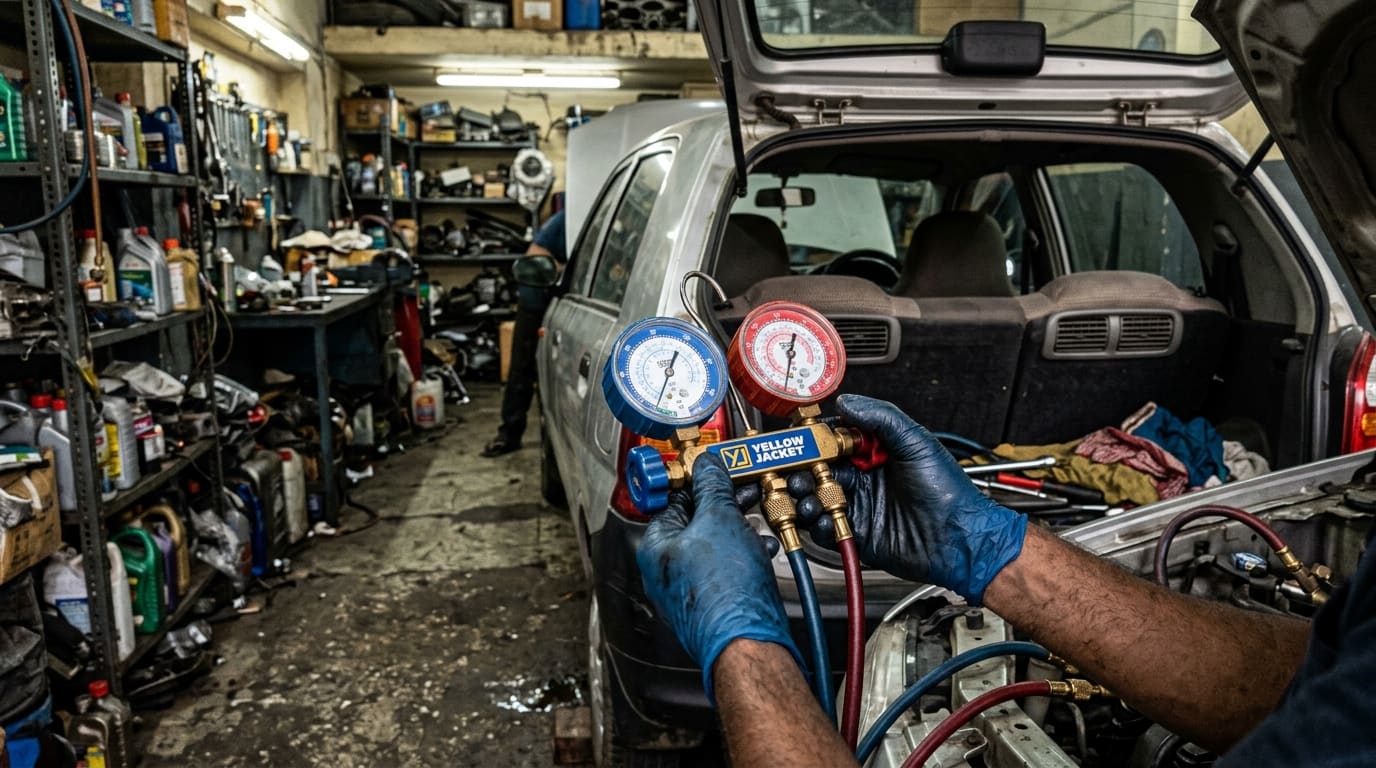
The line feeding the rear evaporator runs under the car's floor or along the B-pillar. Cars that have had body work, a raised door-sill repair, or even an interior retrim can end up with a partial kink in this pipe. A kink restricts flow enough to starve the rear coil without triggering a major pressure alarm in the front circuit. We run the system on gauges and watch low-side pressure before we open anything.
4. Rear evaporator airflow, cabin filter
The Ertiga does not have a separate rear cabin filter on most variants, but the rear evaporator intake can pack with dust over time. If the airflow feels reduced and not absent, check whether the intake grille is clean. This is an owner check that costs nothing.
5. Low refrigerant charge
If all of the above check out, a low charge becomes possible, but it should show on pressure readings, and in most cases both circuits would show some degradation before only the rear stops. Maruti does not publish the Ertiga's refrigerant charge in the India owner's manual. The charge figure for your specific car is on the under-bonnet label, usually on the slam panel. Any workshop topping up the gas should read that label, recover what is in the system, and charge back to the stated weight, not fill by feel.
The refrigerant charge question
We see Ertiga owners who have already had gas put in at another workshop and come to us because the rear is still not cooling. In most of those cases the actual fault was the expansion valve or the blower, and the gas top-up made no difference because the charge was not the problem.
The check that separates "low gas" from "local rear fault" is running the system on manifold gauges and watching both circuits respond to a load change. That takes about fifteen minutes. Skipping it and adding gas is how a car ends up overcharged, which causes its own set of problems.
What the checkup costs
The free 30-point A/C and electrical checkup is ₹0, takes about fifteen minutes and produces a written report. It covers both front and rear circuits, and it is what identifies which of the causes above is yours before any part is opened or quoted.
If the answer is the refrigerant, a gas fill is quoted in writing after the checkup, for a single or a double module, and the leak check is included either way. If the answer is the expansion valve, blower motor or pipework, we quote after the diagnosis, the range between those repairs is too wide for a printed number.
Related guides
See Maruti Suzuki service in Chennai, why car AC stops cooling, the Baleno compressor short-cycling guide, and how we quote.
If the rear vents have weak airflow rather than warm air, see also cabin filter replacement. For compressor-related noise, read how we decide whether a compressor needs replacing.
